A Complete Guide to Wellness, Fitness, and Modern Healthcare In today’s fast-paced life, health has become our most valuable asset. From daily wellness habits to managing chronic diseases and accessing nearby healthcare services, understanding the basics of health can help us live longer, happier, and more productive lives. This article provides a complete overview of general wellness, fitness, major health conditions, public health concerns, and local healthcare services. General Wellness: The Foundation of a Healthy Life General wellness is not just about avoiding illness; it is about maintaining balance in physical, mental, and emotional health. Simple habits like getting 7–8 hours of sleep, drinking enough water, eating balanced meals, and managing stress play a major role in overall well-being. Practices such as meditation, deep breathing, and limiting screen time can significantly improve mental clarity and emotional stability. Fitness and Physical Activity Regular physical ...
Hormones in Animals
Endocrine System: The endocrine system is composed of several endocrine glands. A ductless gland is called an endocrine gland. The endocrine gland secretes its product directly into the bloodstream. Hormones are produced in the endocrine glands. Hormone is mainly composed of protein. Hormones assist the nervous system in control and coordination. The nervous do not react to every nook and corner of the body and hence hormones are needed to affect control and coordination in those parts. Moreover, unlike nervous control, hormonal control is somewhat slower.
Exocrine Gland: Exocrine glands are glands that discharge secretions using ducts, which open onto an epithelial surface.
Hormones: These are the chemical messengers secreted in very small amounts by specialised tissues called ductless glands. They act on target tissues/organs usually away from their source. Endocrine System helps in control and coordination through chemical compounds called hormones.
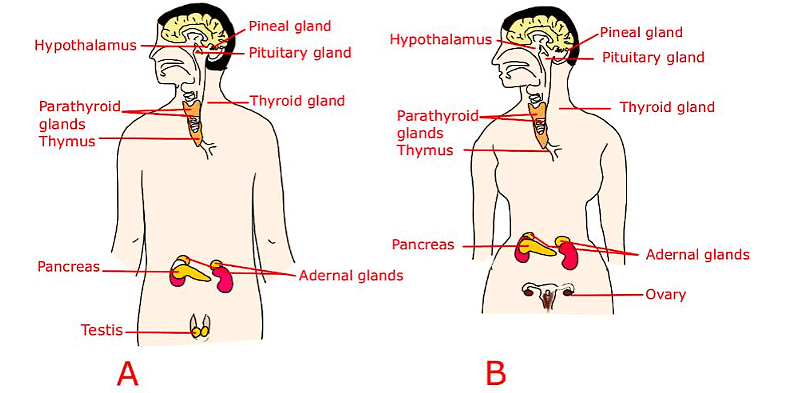 IEndoc rine Glands in (a) Male (b) Female
The list of endocrine gland with the hormones names and their functions are given below:
1. Pituitary gland
- It is a pea-sized gland located at the base of the brain.
- It is the master gland, as it controls the secretions of all the other endocrine glands.
- It also secretes Growth Hormone (GH).
- Under-secretion of GH causes Dwarfism, and over-secretion causes Gigantism in children.
2. Thyroid Gland:
- It is a butterfly-shaped gland located in the throat.
- It secretes the hormone ‘Thyroxine’, which regulates the metabolism of the body.
- Iodine is required to synthesize thyroxine in the body.
- In the case of iodine deficiency, under-secretion of thyroxine leads to goitre
3. Pancreas:
- It is a leaf-like gland present by behind the stomach in the abdomen.
- It is an endocrine as well an exocrine gland.
- As an endocrine gland, it manufactures two hormones – Insulin and glucagon.
- Both these hormones act antagonistically and regulate the sugar level in the blood.
- As an exocrine gland, it secretes enzymes to break down the proteins, lipids, carbohydrates and nucleic acids in food.
- An insufficient amount of insulin from the pancreas leads to diabetes.


4. Adrenal Gland:
- Occurs in pairs above each kidney.
- It decreases in size with age.
- Secrets the hormone adrenaline
Comments
Post a Comment